
Sub-assembly & Kitting
Consolidates multi-component medical or industrial items into final deliverable units.
Manufacturers across the medical device, injection molding, and metal fabrication industries face a common challenge: how to put a permanent, precise mark on a part that isn’t flat. Pad printing solves that problem.
At Universal Promo, we’ve built our entire operation around this capability for over 50 years, and this guide walks through how the process works, what substrates it can support, and how we provide specialized technical expertise required to ensure every mark meets stringent industrial standards.
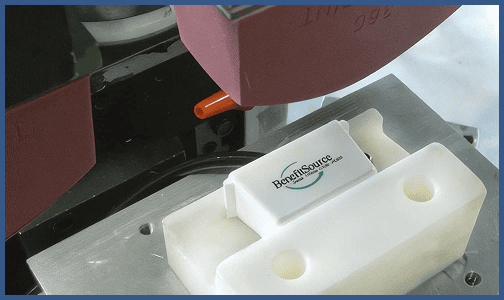
Our cross-slide pad printer moves the pad and substrate along independent axes, which keeps registration tight even across multiple print stations on a single part. Our engineering team builds custom nesting fixtures for every job, so each unit sits in the exact same position from the first part to the last. This dedicated hardware setup defines our precise approach to custom pad printing.
Because our inks dry quickly, we can layer multiple colors onto the same part in one production run without smearing or color bleed. Our equipment holds tight registration between colors, so multi-color logos and fine text stay crisp instead of blurring at the edges.
Part size and imprint area both influence pad selection and cycle time. Small components, like dosing droppers and medicine cups, require a different pad geometry than larger fabricated housings. We evaluate your part’s geometry during quoting, not after, to avoid surprises once production starts.

Ink performance varies significantly across different materials due to chemical composition and surface characteristics. Selecting the proper ink formulation and surface treatment ensures permanent adhesion across all production substrates.
Ink adhesion depends heavily on a substrate’s surface energy. High-energy materials, such as most metals and glass, accept ink readily because their molecular structure bonds well with standard inks. Low-energy plastics, including polypropylene and polyethylene, resist adhesion and often need a surface treatment, like flame or corona treatment, before printing. Understanding this distinction upfront prevents adhesion failures down the line.
Adhesion is the single most common question we hear during the RFQ process, and for good reason: a print that peels or scratches off defeats the purpose of branding a part at all. We run adhesion testing on your specific substrate before committing to full production, verifying that our ink and surface preparation hold up under real-world handling.
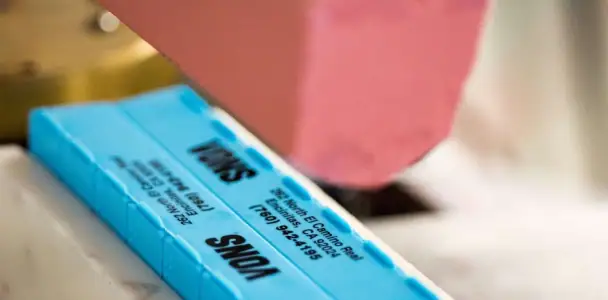
We’re FDA registered for medical device work and print in a HEPA-filtered, climate-controlled clean environment built for components like syringes, dosing devices, and hearing aids. Every medical project uses Class VI medical-grade inks, which meet USP biocompatibility standards and hold up against sterilization by chemicals, heat, and gas. For decades, our specialized medical device pad printing solutions have satisfied rigorous regulatory expectations. Learn more on our medical device printing page.
Injection molders integrate pad printing late in the manufacturing cycle when scrap costs are highest, making first-article precision and lot-to-lot repeatability critical. Custom-engineered silicone pad geometries and CNC-machined nesting fixtures lock parts into place to eliminate registration drift on complex molded curves, texture transitions, and parting lines.
Fabricated metal parts call for durable, chemical-resistant markings that survive handling, assembly, and field use. We match ink chemistry to the base metal and any coating already applied to the part.
Beyond industrial parts, we print logos and branding onto promotional products, drinkware, and display items, applying the same registration and color-matching standards we use on medical and industrial work.

We stock solvent-based and UV-curable inks, spanning seven to eight formulations, and select the right one based on your substrate, end-use environment, and any regulatory requirements. Solvent inks generally offer strong adhesion across a wide range of plastics, while UV inks cure instantly and resist scratching on rigid surfaces. It is this depth of resource that sets major pad printing companies apart from basic decorators.
For products that will face autoclaving, chemical wipe-downs, or repeated handling, our Class VI inks are formulated to resist degradation from water, chemicals, and sterilization gases without fading or flaking. This specialized chemical cross-linking is critical to successful medical device pad printing.

We hold ISO 9001:2015 certification, and every print job comes with documentation covering material specifications, process parameters, and quality checkpoints. That paper trail gives design engineers and quality teams the traceability they need for audits, supplier reviews, and regulatory submissions.
Industrial contract pad printing often requires downstream secondary finishing to streamline supply chains. Universal Promo integrates post-print operations directly into the production workflow:

Lead times vary by project scope. A single logo on one item typically ships within three weeks, general repeat orders run about two weeks, and multi-item decoration projects can take longer depending on complexity. Our turnkey contract pad printing division works with businesses of all sizes, from prototype runs to high-volume production, and we’ll tell you upfront if a project falls outside our scope so you’re not left waiting.

Navigating complex part geometries, stringent medical compliance, and tight adhesion tolerances requires specialized pad printing capability. With over 50 years of domestic manufacturing experience, custom nesting fixture design, and ISO 9001:2015 quality control, Universal Promo delivers repeatable results from prototype to full-scale production runs.
Ready to validate your part’s print specification? Request a quote or contact us to discuss substrate testing, lead times, and tooling.

Pad printing is an indirect offset process built for one specific job: transferring a two-dimensional image onto a three-dimensional, often irregular, surface. Where screen printing needs a flat plane and digital printing works best on rigid, even substrates, custom pad printing handles curves, dips, textures, and tight corners without distorting the artwork. This flexible application method makes our contract pad printing services indispensable for complex geometry.
We start by etching your design into a metal or polymer plate called a cliché. A doctor blade wipes ink across the plate, leaving color only in the etched image. A silicone pad then presses down onto the plate, picks up the ink in the exact shape of your design, and transfers it onto your part. The pad’s flexibility is what lets it wrap around a curved syringe barrel or settle into a recessed logo panel that other print methods can’t reach.

We regularly print on plastic components, metal fabricated parts, glass, and silicone items such as medical tubing and electronic controls. If your product has a contoured, convex, or uneven surface, there’s a strong chance we can print it. When looking at pad printing on plastic or other challenging materials, choosing experienced pad printing companies guarantees proper ink selection. Explore our Complex and Irregular Surfaces Pad Printing page for material-specific details.
Our cross-slide pad printer moves the pad and substrate along independent axes, which keeps registration tight even across multiple print stations on a single part. Our engineering team builds custom nesting fixtures for every job, so each unit sits in the exact same position from the first part to the last. This dedicated hardware setup defines our precise approach to custom pad printing.
Because our inks dry quickly, we can layer multiple colors onto the same part in one production run without smearing or color bleed. Our equipment holds tight registration between colors, so multi-color logos and fine text stay crisp instead of blurring at the edges.

Part size and imprint area both influence pad selection and cycle time. Small components, like dosing droppers and medicine cups, require a different pad geometry than larger fabricated housings. We evaluate your part’s geometry during quoting, not after, to avoid surprises once production starts.

Ink performance varies significantly across different materials due to chemical composition and surface characteristics. Selecting the proper ink formulation and surface treatment ensures permanent adhesion across all production substrates.

Ink adhesion depends heavily on a substrate’s surface energy. High-energy materials, such as most metals and glass, accept ink readily because their molecular structure bonds well with standard inks. Low-energy plastics, including polypropylene and polyethylene, resist adhesion and often need a surface treatment, like flame or corona treatment, before printing. Understanding this distinction upfront prevents adhesion failures down the line.
Adhesion is the single most common question we hear during the RFQ process, and for good reason: a print that peels or scratches off defeats the purpose of branding a part at all. We run adhesion testing on your specific substrate before committing to full production, verifying that our ink and surface preparation hold up under real-world handling.


We stock solvent-based and UV-curable inks, spanning seven to eight formulations, and select the right one based on your substrate, end-use environment, and any regulatory requirements. Solvent inks generally offer strong adhesion across a wide range of plastics, while UV inks cure instantly and resist scratching on rigid surfaces. It is this depth of resource that sets major pad printing companies apart from basic decorators.
For products that will face autoclaving, chemical wipe-downs, or repeated handling, our Class VI inks are formulated to resist degradation from water, chemicals, and sterilization gases without fading or flaking. This specialized chemical cross-linking is critical to successful medical device pad printing.
We hold ISO 9001:2015 certification, and every print job comes with documentation covering material specifications, process parameters, and quality checkpoints. That paper trail gives design engineers and quality teams the traceability they need for audits, supplier reviews, and regulatory submissions.
Industrial contract pad printing often requires downstream secondary finishing to streamline supply chains. Universal Promo integrates post-print operations directly into the production workflow:
Consolidates multi-component medical or industrial items into final deliverable units.
Provides shrink wrapping and Clean Environment bagging in our Maple Grove, Minnesota facility.

Delivers metallic foil transfers for flat or gently contoured components when liquid ink is not ideal.
Lead times vary by project scope. A single logo on one item typically ships within three weeks, general repeat orders run about two weeks, and multi-item decoration projects can take longer depending on complexity. Our turnkey contract pad printing division works with businesses of all sizes, from prototype runs to high-volume production, and we’ll tell you upfront if a project falls outside our scope so you’re not left waiting.
Navigating complex part geometries, stringent medical compliance, and tight adhesion tolerances requires specialized pad printing capability. With over 50 years of domestic manufacturing experience, custom nesting fixture design, and ISO 9001:2015 quality control, Universal Promo delivers repeatable results from prototype to full-scale production runs.
Ready to validate your part’s print specification? Request a quote or contact us to discuss substrate testing, lead times, and tooling.