Pad Printing Services for Complex and Irregular Surfaces
Pad Printing Services for Complex and Irregular Surfaces
Complex geometry is what UniversalPromo’s custom pad printing process is designed for. We work with curved, contoured, and irregular surfaces across plastic, metal, glass, and silicone substrates, backed by more than 50 years of in-house tooling experience and ISO 9001:2015 certification. Whether you’re sourcing contract pad printing for a medical device program or evaluating vendors for an injection-molded component line, UPI’s capabilities are built for demanding specifications.
For manufacturing and design engineers evaluating pad printing companies for a demanding application, the following directly covers UPI’s process capabilities, substrate range, and quality standards.
What UPI’s Pad Printing Process Handles
Material and surface geometry are the two variables that define whether a pad printing job is feasible and where most vendor conversations break down.
Substrates: Plastic, Metal, Glass, Silicone, and More
We run pad printing on a broad substrate range, including:
- Plastics, including ABS, polycarbonate, polystyrene, polypropylene, polyethylene, nylon, acrylic, PVC, kydex, and soft-touch elastomers
- Metals, including fabricated steel, aluminum, and coated metal components
- Glass and ceramics
- Silicone and rubber-based materials
- Painted and powder-coated surfaces
- Wood and wood composite surfaces
Ink selection is matched to the substrate and validated through adhesion testing before full production runs begin. The goal is permanent adhesion.
Surface Types: Curved, Contoured, and 3D Geometries
Beyond material compatibility, the process is designed to follow the part instead of forcing the part to fit the process.
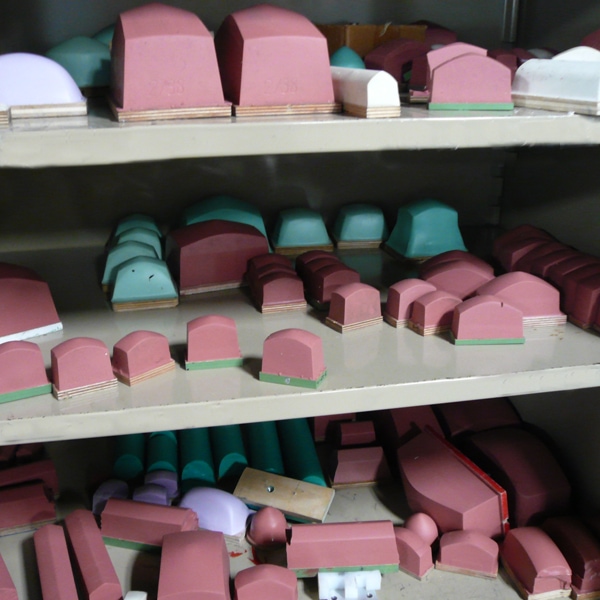
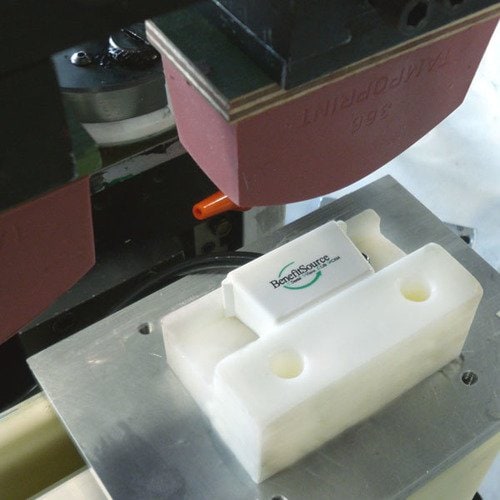
The silicone pad at the heart of this process deforms to match a part’s surface during transfer, then releases cleanly without distorting the image. That makes it well-suited for:
- Concave and convex profiles
- Cylindrical and tubular forms (including full-wrap rotational printing)
- Recessed and raised surface areas
- Multi-location printing on a single part in one pass
Parts with tight imprint areas or complex geometry are where our custom-engineered tooling makes a difference. Fixtures are designed and built in-house to hold parts consistently across long production runs.


Process Capabilities and Production Standards
Substrate range is only part of the picture. How ink performs on that substrate is where custom pad printing quality is actually won or lost.
Ink Adhesion, Color Matching, and Resolution
Our pad printing process supports single-color through multi-color work, with tight registration across all passes. Key capabilities include:
- Multi-color registration for complex artwork, and fine-detail graphics
- In-house color matching against Pantone standards
- High-resolution output on irregular and contoured surfaces where screen printing is not geometrically feasible
- Fast ink cure times that allow multiple colors to be applied to the same part in a single production cycle
- Medical-grade inks – biocompatible, sterilization-resistant formulations for healthcare applications
We also offer surface pre-treatment for substrates that need improved adhesion before printing
ISO 9001:2015 Quality Controls
UPI is ISO 9001:2015-certified and FDA-registered for medical device manufacturing. Our quality processes are documented, auditable, and consistently applied across jobs. From artwork review and pre-production sign-off through final inspection, every part is checked before it ships. For regulated industries, that traceability matters.
Industries Served
The industries we work with have different marking standards, regulatory requirements, and substrate profiles. Each shapes how we set up the job.
- Medical devices: Catheters, syringes, housings, and diagnostic equipment requiring biocompatible inks, sterilization resistance, and precise, legible markings for regulatory compliance
- Injection-molded parts: Logos, identification text, and multi-color graphics on polycarbonate, polypropylene, and other molded resins
- Metal fabricators: Durable markings on fabricated steel and aluminum components for industrial identification and branding
- Promotional and commercial products: Custom graphics on pens, tools, housings, and display components where print quality and adhesion durability are required
UPI also serves blow molders, roto molders, 3D printing operations, and store display manufacturers with precise, durable decoration for finished parts.
Value-Added Services Paired With Pad Printing
Pad printing is often one step in a larger production sequence. UPI is set up to handle what comes next.
Assembly, Packaging, and Kitting
Once pad printing is complete, we can move directly into:
- Assembly of printed components into sub-assemblies or finished products
- Packaging and kitting for distribution-ready shipment
- Laser engraving or hot stamping where the application calls for a different marking method alongside pad print
Keeping multiple finishing steps under one roof reduces handoffs, simplifies scheduling, and maintains consistent quality control throughout the process.
Getting a Quote
UPI has been solving difficult print jobs for over 50 years, and custom pad printing remains our primary focus. Whether you’re sourcing contract pad printing for a medical device program or looking for a production partner for injection-molded components, our team has the tooling, ink knowledge, and quality infrastructure to support it.
The fastest way to get accurate pricing is to send us your part details directly. Request a quote and our team will follow up with specifics.